
October 24, 2025
Meeting Recap
Location: HQ at the Highlands
Topic: Microcredentials
Topics
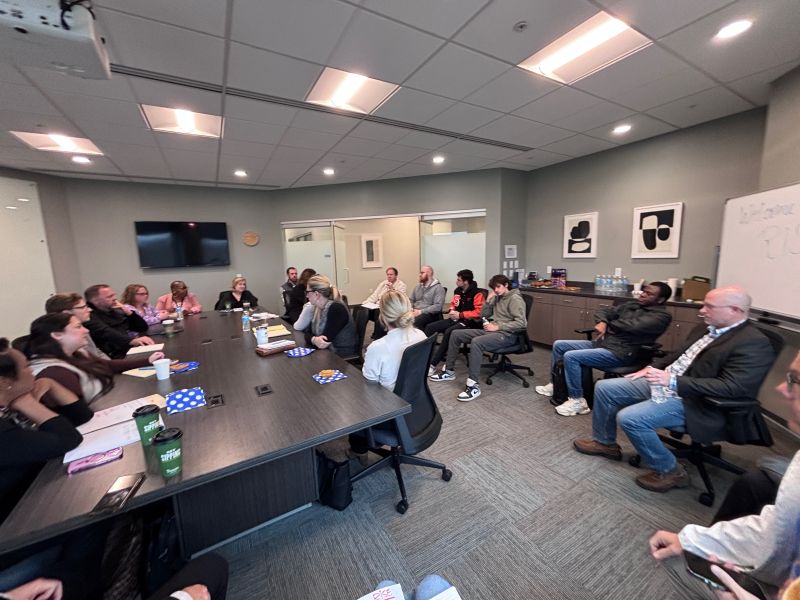
RISE participants heard from a panel of presenters about microcredentials.
Meeting Notes
Main Topics Discussed
1. Overview and Purpose of the Meeting
Objective: The steering committee convened to devise discussion plans for upcoming meetings, with this session devoted to micro credentials.
Participants: Multiple stakeholders from higher education, K-12 institutions, and local businesses were present to discuss perspectives and implementation strategies.
2. Micro Credentials: Definition and State Initiatives
Definition: Micro credentials refer to skill-specific, short-term educational achievements that are distinct from traditional degrees, often referred to as “badges.”
Statewide Efforts: The West Virginia Higher Education Policy Commission (HEPC) is pioneering these credentials under the “West Virginia Credentials” initiative.
Purpose: To allow students to quantify and showcase skills gained during and outside the pursuit of full length degrees.
Transcript Reform: Traditionally, transcripts only show completed degrees; micro credentials attempt to articulate partial achievements and relevant competencies.
Relevance: Most college students (roughly 80%) are working during their studies; micro credentials aim to support and certify upskilling or reskilling as they progress or pause their education.
3. Institutional Approaches to Micro Credentials
Four-Year Colleges
Current Gaps:
Difficulty in capturing and communicating transferable skills earned prior to degree completion.
Need to better quantify and articulate competencies like critical thinking and experiential learning.
Badging Process: Micro credentials verified through a “badging” system where employers can see precise competencies met by each student.
Students own their badges, allowing inclusion in resumes, LinkedIn, email signatures, etc.
Two-Year Colleges & Community Colleges
Flexibility: Greater ability to create shorter, stackable credentials and skill sets; sometimes already existing under terms like “advanced skill sets.”
Three Models for Micro Credential Development:
1. Bundling Existing Skills: Reviewing programs to formalize embedded skills as micro credentials, particularly those already recognized by industry (e.g., Microsoft certifications).
2. Business-Driven Design: Collaborating directly with employers to develop new credentials aligned exactly to their desired skills (e.g., industrial professional skills for chemical plants).
3. Internal Upskilling: Creating professional development micro credentials for faculty/staff, incentivizing job-related growth.
Credit and Non-Credit Pathways: Credentials can be credit-bearing or non-credit (workforce development); non-credit can bridge into credit pathways for certificates or degrees.
4. Employer and Career Services Perspectives
Alignment with Workforce Needs:
Continual engagement with employers is vital to ensure credentials match current hiring requirements.
Importance of understanding and regularly updating the list of in-demand skills.
Student Preparation:
Critical for colleges to display, own, and prove employability skills to employers.
Challenges include local students competing nationally/regionally, and existing gaps between what is taught (e.g., reliance on Google Docs) versus what is used in the workplace (e.g., Microsoft suite).
High School Context and Integration
Comparison to Graduation Seals: Ohio high schools employ an industry credentialing model (“graduation seals”), which are similar to micro credentials.
Digital Badges: Implementation of digital badges rather than “physical stickers,” with detailed breakdowns of competencies accessible online.
5. Skills Gap and Competency Verification
Basic Skills Deficiency: Employers observe even college graduates lacking basic technical skills (e.g., reading a tape measure, proficiency in Excel, Microsoft Office).
Issue particularly pronounced due to differences between educational tools (Google Docs) and business expectations (Microsoft Office).
Micro Credential Benefits:
Badges specify exact competencies (moving beyond generic claims of proficiency).
Embedded industry certifications (e.g., Microsoft Word/Excel certifications now being tied directly to curriculum).
Badges support validation of actual skill levels for both students and employers.
6. Technology and AI Integration
Tools Evolution: Emphasis placed on learning not only basic software but also newer collaborative tools (Teams, Copilot, AI readiness).
Anticipating Future Needs:
Micro credentials to evolve alongside technology (e.g., AI-created spreadsheets overseen by humans with core skills).
Faculty are updating courses to ensure alignment with both current software and anticipated employer needs.
7. Pathways and Partnerships
Business Partnerships:
Local employers (IT firms, banks, etc.) collaborate with colleges for talent development, scholarships,
internships, and direct pipelines from high school or two-year to employment.
Desire for deeper relationships—employers identifying and developing talent at earlier educational stages.
Work-Based Learning: Emphasis on dual paths (college credit & work-based learning) for seniors in high school; push to reimagine traditional education and career preparation.
8. Inclusivity and Continuing Education
Non-Traditional Learners:
Importance of not neglecting adult learners and those between jobs or entering a “phase two” career.
Micro credentials provide flexible pathways for upskilling, reskilling, and career pivots for all ages, not just youth.
9. Soft Skills and Foundational Competencies
Industry Feedback:
Even in technical industries, “soft skills” (communication, eye contact, documentation, teamwork) are considered essential.
Micro credentials should reflect both hard (technical) and soft skills.
10. Expanding Micro Credentials to New Areas
Cross-Disciplinary Opportunities:
Suggestion to merge marketing, graphic design, digital content, and UI/UX skills into stackable micro credentials.
High employer demand for employees who bring interdisciplinary skills—opportunities for badges starting at the high school level.
11. Professional Development and Employer Support
Internal Development: Employers increasingly invest in funding certifications, professional development time, and micro credentials for their current workforce, tying these investments to productivity and employee retention.
Adaptation in Policies: Companies adjust reimbursement and training policies to better support learning outcomes and culture.
12. Gaps in Workplace Readiness
Financial & Benefits Literacy:
Significant discussion about a deficit in basic financial and HR knowledge (e.g., understanding benefits, 401k, insurance types, employment laws like FMLA and ADA).
Suggestion for integrating such topics into educational curricula and micro credentials for true workforce readiness.
Action Items
1. Employer Feedback Collection:
Institutions and steering committee to conduct focused, recurring dialogues with local employers to refine desired skills and competencies for micro credentials.
2. Curriculum Revision:
Colleges to audit and revise first-year seminars and core courses to robustly include Microsoft Office (including Teams, Copilot), email etiquette, and other digital skills.
Consider embedding industry certifications directly into curricula.
3. K-12 Collaboration:
Increase engagement with high schools to align existing industry credentialing (e.g., graduation seals) with college-level badge structures, and to promote stackable pathways.
4. Expand Soft Skills Micro Credentials:
Explore ways to badge and certify essential soft skills as part of technical training.
5. Broaden Micro Credential Offerings:
Develop interdisciplinary credentials in areas like marketing + graphic design + UI/UX, with options starting at the high school level and stackable through college.
6. Upskilling for Adult and Non-Traditional Learners:
Ensure micro credential initiatives and communication also reach adult learners seeking new skills or career pivots.
7. Financial and Workplace Readiness Modules:
Develop micro credentials or mandatory modules covering employee benefits, insurance, retirement planning, and employment laws, applicable at both high school and college levels.
8. Enhanced Employer Engagement:
Build or strengthen internship, job shadowing, and scholarship pipelines by formalizing business partnerships; pilot expanded work-based learning programs.
9. Tracking and Data Analysis:
Institutions to improve data tracking on where students and graduates are being employed and which credentials are yielding hiring advantages.
10. Marketing and Communication:
Clear informational materials and sessions for students, parents, and employers about the value and verification process of micro credentials.
Follow-Up Points / Meetings
Set follow-up meeting (date TBD) to revisit micro credential progress, review outcomes from employer engagement sessions, and assess next steps for integrating suggested curriculum changes.
Circulate draft proposals for new stackable badge sequences (e.g., for marketing + design, financial literacy) and solicit broad feedback.
Continue dialogue between high schools and colleges to synchronize credential language and ensure pipelines for student progress.
Track and report on pilot programs for embedding certifications into required coursework and monitor outcomes.
Additional Observations
Acknowledgement of Progress: West Virginia’s efforts in micro credentialing are recognized as ahead nationally, though there is consensus that adaptation must be ongoing as technology and workforce needs shift.
Emphasis on Customization: Recognition that employer needs are highly individualized; education partners must remain flexible and responsive to local conditions.
Equity in Opportunity: Consistent call to ensure all learners—regardless of age or stage—are considered in the design and rollout of new credentialing initiatives.
Urgency for “Baseline Competency”: Multiple participants voiced concern that even basic digital and workplace readiness skills are lacking and must be addressed systematically.
Sign Up for the RISE Mailing List
If you are not receiving RISE emails, sign up for our Constant Contact mailing list.
 RISE
RISE 